
In today’s digital world, data is one of the most valuable assets for any organization. Businesses collect massive amounts of data every day — from customer information and financial records to operational and marketing insights. However, without proper control, management, and policies, data can quickly become disorganized, inaccurate, insecure, or even risky.
This is where Data Governance becomes essential.
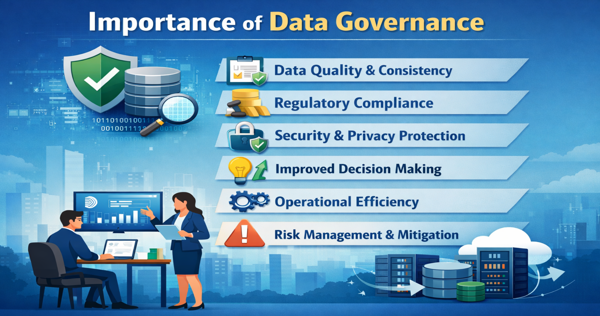
Data governance ensures that data is accurate, secure, consistent, compliant, and usable across an organization. It provides a structured framework for managing data effectively, enabling businesses to make better decisions and reduce risks.
Let’s explore why data governance is so important in modern organizations.
What is Data Governance?
Data Governance is a structured framework that defines how data is collected, stored, accessed, shared, protected, and maintained across an organization. It establishes clear policies, procedures, standards, and responsibilities to ensure that data remains accurate, secure, consistent, and compliant throughout its lifecycle.
In simple terms, Data Governance answers three critical questions:
- Who owns the data?
- Who can access or modify the data?
- How is the data protected and maintained?
It is not just about technology — it is about people, processes, and policies working together to manage data effectively.
It focuses on:
- Data quality
- Data security
- Data privacy
- Data consistency
- Regulatory compliance
- Data ownership and accountability
- Engineering project management services
In simple terms, data governance defines who can use data, how they can use it, and how it is protected.
Why is Data Governance Important?
1. Ensures High Data Quality
Poor-quality data leads to poor decisions. Inaccurate, incomplete, or duplicate data can mislead business strategies.
Data governance:
- Establishes data quality standards
- Removes duplicates and inconsistencies
- Maintains data accuracy
- Standardizes data formats
When data is reliable, organizations can make informed and confident decisions.
2. Improves Decision-Making
Business intelligence, analytics, and AI systems depend on clean and well-structured data.
With strong governance:
- Reports are accurate
- Insights are trustworthy
- Forecasts are more reliable
- AI models perform better
- Digital marketing
Better data leads to better strategies and improved business outcomes.
3. Enhances Data Security
Cyber threats and data breaches are increasing every year. Sensitive data such as customer information, financial records, and employee details must be protected.
Data governance:
- Defines access control policies
- Implements role-based permissions
- Monitors data usage
- Reduces unauthorized access
This strengthens the organization’s cybersecurity framework.
4. Supports Regulatory Compliance
Governments around the world have strict data protection laws such as:
- GDPR
- HIPAA
- CCPA
- Data Protection Acts
Non-compliance can result in heavy fines and legal issues.
Data governance ensures:
- Proper documentation
- Secure storage of personal data
- Controlled data sharing
- Compliance with industry regulations
This protects both the organization and its customers.
5. Increases Operational Efficiency
When departments store and manage data differently, confusion arises. Teams may waste time searching for correct information.
Data governance:
- Creates standardized data definitions
- Removes data silos
- Improves collaboration
- Reduces duplication
This improves workflow efficiency and productivity.
6. Builds Customer Trust
Customers expect organizations to handle their data responsibly.
When businesses:
- Protect personal information
- Maintain transparency
- Ensure data accuracy
They build trust and long-term relationships with customers.
Strong governance shows customers that their privacy matters.
7. Enables Digital Transformation
Modern technologies like:
- Artificial Intelligence
- Machine Learning
- Big Data Analytics
- Cloud Computing
- Web development
All rely on well-managed data.
Without governance, digital transformation initiatives can fail due to inconsistent or poor-quality data. Data governance acts as the foundation for innovation and growth.
Key Components of Data Governance
1. Data Policies and Standards
Clear rules on how data should be handled.
2. Data Stewardship
Assigning responsibility to individuals for managing data quality and integrity.
3. Data Quality Management
Ensuring data is accurate, complete, and consistent.
4. Metadata Management
Organizing information about data for better tracking and usage.
5. Data Security and Privacy Controls
Protecting sensitive information from misuse.
Core Objectives of Data Governance
1️⃣ Data Accuracy
Ensures all operational and business data is correct and up-to-date.
2️⃣ Data Consistency
Maintains uniform data standards across departments such as engineering, procurement, and operations.
3️⃣ Data Security
Protects sensitive information like contracts, financial records, and technical drawings.
4️⃣ Regulatory Compliance
Ensures adherence to industry regulations and documentation standards.
5️⃣ Accountability
Clearly defines data owners, stewards, and user responsibilities.
Challenges Without Data Governance
Organizations that ignore data governance may face:
- Inaccurate reporting
- Compliance penalties
- Security breaches
- Poor customer experience
- Inefficient operations
- Failed analytics projects
In short, unmanaged data becomes a liability instead of an asset.
Real-World Example
Imagine a retail company analyzing customer purchase data. If customer names are duplicated, addresses are outdated, or product categories are inconsistent, sales analysis becomes unreliable.
With proper data governance:
- Customer records are standardized
- Product information is consistent
- Reports reflect real performance
This enables smarter marketing strategies and improved customer targeting.
Benefits of Strong Data Governance
- Better business decisions
- Reduced compliance risks
- Improved data security
- Higher operational efficiency
- Increased customer trust
- Successful AI and analytics implementation
Data governance transforms raw data into a strategic advantage.
The Future of Data Governance
As data volume continues to grow, governance will become even more critical. Organizations are increasingly adopting:
- Automated data governance tools
- AI-powered data quality monitoring
- Cloud-based governance platforms
- Real-time compliance tracking
Future-ready businesses understand that governance is not optional — it is essential.
Conclusion
Data is the backbone of modern business, but without proper governance, it can create more problems than opportunities. Data governance ensures data is secure, reliable, compliant, and accessible to the right people at the right time.
In a world driven by analytics, AI, and digital transformation, strong data governance is no longer a luxury — it is a necessity.
Organizations that invest in effective data governance today will build a strong foundation for smarter decisions, sustainable growth, and long-term success.
About the Author