
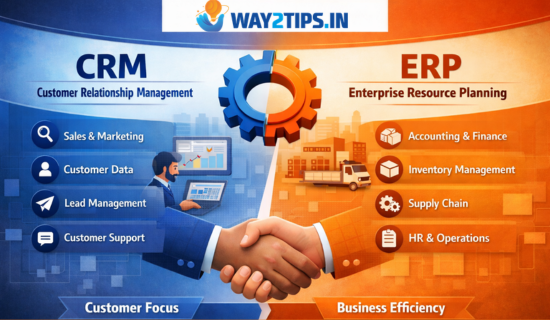
In today’s competitive business environment, companies rely on powerful software systems to manage operations, improve customer relationships, and increase efficiency. Two of the most important business management systems are CRM (Customer Relationship Management) and ERP (Enterprise Resource Planning).
Although both systems help organizations streamline processes, they serve different purposes. Let’s explore CRM and ERP systems in detail, understand their differences, benefits, and how businesses can use them effectively.
What is a CRM System?
A CRM (Customer Relationship Management) system is software designed to manage a company’s interactions with current and potential customers. It helps businesses improve customer service, increase sales, and build long-term relationships.
Popular CRM Examples:
- Salesforce
- HubSpot
- Zoho CRM
- Microsoft Dynamics 365
Key Features of CRM:
- Contact management
- Sales pipeline tracking
- Lead management
- Email marketing automation
- Customer support ticketing
- Reporting and analytics
Benefits of CRM:
- Improves customer satisfaction
- Increases sales conversions
- Better communication between sales teams
- Centralized customer data
- Enhanced marketing campaigns
CRM systems are mainly used by sales, marketing, and customer service teams.
What is an ERP System?
An ERP (Enterprise Resource Planning) system is software that integrates and manages core business processes across departments in a single system.
Popular ERP Examples:
- SAP ERP
- Oracle NetSuite
- Odoo
- Tally
Key Features of ERP:
- Accounting and finance management
- Inventory control
- Human resource management
- Supply chain management
- Procurement
- Manufacturing management
Benefits of ERP:
- Improved operational efficiency
- Real-time data across departments
- Better financial management
- Reduced operational costs
- Improved productivity
- E-commerce multimedia
ERP systems are mainly used by finance, HR, operations, and management teams.
CRM vs ERP: Key Differences
| Feature | CRM | ERP |
|---|---|---|
| Focus | Customer relationships | Business processes |
| Users | Sales & Marketing | Entire organization |
| Goal | Increase revenue | Improve efficiency |
| Data | Customer-centric | Company-wide data |
| Implementation Cost | Generally lower | Usually higher |
When Should a Business Use CRM?
A business should implement a CRM system when:
- Sales team struggles to track leads
- Customer data is scattered
- Follow-ups are inconsistent
- Marketing campaigns need automation
- Customer support response time is slow
Small and medium businesses often start with CRM before moving to ERP.
When Should a Business Use ERP?
A company should consider ERP when:
- Multiple departments use separate systems
- Financial reporting is complex
- Inventory tracking is inaccurate
- Business operations are growing rapidly
- Manual processes slow down productivity
Medium to large enterprises commonly invest in ERP systems.
Can CRM and ERP Work Together?
Yes! Many modern solutions integrate CRM and ERP systems.
For example:
- Microsoft Dynamics 365 integrates CRM and ERP modules.
- SAP Business One offers both operational and customer management features.
When CRM and ERP are integrated:
- Sales teams can see inventory availability.
- Finance teams can access customer payment history.
- Management gets complete business visibility.
- Web Design and Development
This integration improves decision-making and overall business performance.
Cloud-Based CRM and ERP
Today, many businesses prefer cloud-based systems because they:
- Reduce infrastructure cost
- Offer remote access
- Provide automatic updates
- Improve data security
Cloud platforms like Salesforce and Oracle NetSuite are popular worldwide.
Advantages of Using Both Systems
Companies using both CRM and ERP enjoy:
- 360° view of customers
- Streamlined workflows
- Improved data accuracy
- Faster decision-making
- Scalable growth
Challenges of CRM and ERP Implementation
Despite the benefits, businesses may face challenges such as:
- High implementation cost
- Employee resistance to change
- Data migration issues
- Training requirements
- Customization complexity
Proper planning, training, and choosing the right vendor can overcome these challenges.
Final Thoughts
CRM and ERP systems are powerful tools that help businesses grow and operate efficiently.
- CRM focuses on improving customer relationships and increasing sales.
- ERP focuses on managing internal business processes and improving operational efficiency.
For growing businesses, starting with CRM and later integrating ERP can be a smart strategy. Larger organizations benefit from implementing both systems together for complete business management.
Investing in the right system depends on your company size, goals, and budget — but in today’s digital world, having at least one of these systems is no longer optional; it’s essential for sustainable growth.
About the Author