

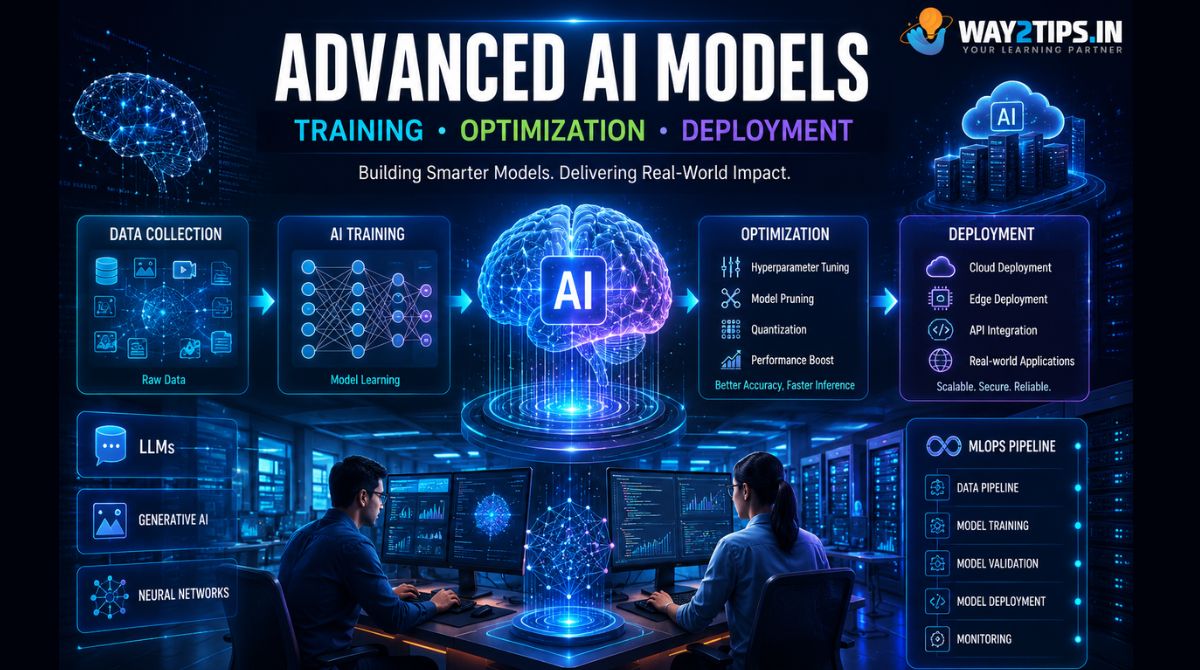
Artificial Intelligence (AI) has transformed from a niche research field into a powerful technology that drives innovation across industries. From virtual assistants and recommendation systems to autonomous vehicles and advanced healthcare diagnostics, AI models are becoming increasingly sophisticated and capable.
Behind every successful AI application lies a complex process involving model training, optimization, and deployment. Understanding these stages is essential for businesses, developers, and technology enthusiasts who want to leverage the full potential of modern AI systems.
What Are Advanced AI Models?
Advanced AI models are machine learning systems designed to perform complex tasks such as natural language processing, computer vision, speech recognition, predictive analytics, and decision-making.
Examples include:
- Large Language Models (LLMs)
- Generative AI Models
- Deep Neural Networks
- Computer Vision Models
- Reinforcement Learning Systems
- Multimodal AI Models
These models learn patterns from massive datasets and use that knowledge to generate predictions, insights, or content.
The AI Model Development Lifecycle
Creating an advanced AI model involves several critical stages:
- Data Collection
- Data Preparation
- Model Training
- Model Optimization
- Testing and Evaluation
- Deployment
- Monitoring and Maintenance
Each stage plays a vital role in ensuring the model performs accurately and efficiently.
Data Collection: The Foundation of AI
Data is the fuel that powers AI systems. The quality and quantity of data directly impact model performance.
Common data sources include:
- Business Databases
- User Interactions
- IoT Devices
- Public Datasets
- Images and Videos
- Text Documents
- Sensor Data
Organizations often spend significant time collecting and organizing high-quality datasets before training begins.
Data Preprocessing and Preparation
Raw data is rarely ready for training. It must be cleaned and structured to improve learning outcomes.
Key preprocessing tasks include:
Data Cleaning
Removing duplicates, correcting errors, and handling missing values.
Data Labeling
Assigning meaningful labels to training examples.
Data Transformation
Converting data into formats suitable for machine learning algorithms.
Feature Engineering
Selecting and creating relevant features that improve model performance.
Proper data preparation can significantly increase model accuracy and reliability.
AI Model Training
Training is the process where an AI model learns patterns from data.
During training:
- Data is fed into the model.
- The model makes predictions.
- Errors are calculated.
- Parameters are adjusted.
- The process repeats thousands or millions of times.
Modern AI models often require powerful hardware such as:
- GPUs
- TPUs
- High-Performance Computing Clusters
- Cloud-Based AI Infrastructure
Training large-scale AI models can take days or even weeks depending on complexity.
Deep Learning and Neural Networks
Many advanced AI systems rely on deep learning architectures.
Popular architectures include:
Convolutional Neural Networks (CNNs)
Used for:
- Image Recognition
- Medical Imaging
- Object Detection
Recurrent Neural Networks (RNNs)
Used for:
- Language Modeling
- Speech Processing
- Time-Series Forecasting
Transformers
Used for:
- Chatbots
- Content Generation
- Language Translation
- Large Language Models
Transformer-based architectures have become the foundation of today’s most advanced AI systems.
Model Optimization Techniques
Once training is complete, optimization improves performance and efficiency.
Hyperparameter Tuning
Adjusting settings such as:
- Learning Rate
- Batch Size
- Number of Layers
- Training Epochs
Model Pruning
Removing unnecessary parameters to reduce model size.
Quantization
Reducing numerical precision to improve speed and lower memory requirements.
Knowledge Distillation
Training smaller models using larger pre-trained models as teachers.
Optimization helps organizations deploy AI more cost-effectively while maintaining high performance.
Model Evaluation and Validation
Before deployment, AI models must be rigorously tested.
Common evaluation metrics include:
- Accuracy
- Precision
- Recall
- F1 Score
- ROC-AUC
- Mean Squared Error
Validation ensures the model generalizes well to real-world scenarios and avoids overfitting.
AI Model Deployment
Deployment makes AI models available for real-world use.
Deployment environments include:
Cloud Deployment
Benefits:
- Scalability
- Easy Maintenance
- Global Accessibility
Edge Deployment
Benefits:
- Lower Latency
- Offline Processing
- Enhanced Privacy
Hybrid Deployment
Combines cloud and edge capabilities for optimal performance.
Modern AI deployment often relies on technologies such as Docker, Kubernetes, APIs, and cloud platforms.
MLOps: Managing AI in Production
MLOps (Machine Learning Operations) combines machine learning with DevOps practices.
Its objectives include:
- Automated Training Pipelines
- Continuous Integration
- Continuous Deployment
- Performance Monitoring
- Model Versioning
- Governance and Compliance
MLOps helps organizations manage AI systems efficiently at scale.
Challenges in AI Deployment
Organizations often face several challenges:
Data Privacy
Protecting sensitive user information.
Model Bias
Ensuring fair and unbiased decision-making.
Security Risks
Preventing adversarial attacks and data breaches.
Scalability
Handling increasing workloads efficiently.
Regulatory Compliance
Meeting legal and industry-specific requirements.
Addressing these challenges is critical for successful AI adoption.
Emerging Trends in Advanced AI
The AI landscape continues to evolve rapidly.
Key trends shaping the future include:
- Generative AI
- Multimodal Models
- Autonomous AI Agents
- Explainable AI (XAI)
- Federated Learning
- AI-Powered Cybersecurity
- Edge AI
- Quantum AI Integration
These innovations are expected to drive the next wave of digital transformation.
Benefits of Advanced AI Models
Organizations adopting advanced AI systems can achieve:
- Improved Productivity
- Better Decision-Making
- Reduced Operational Costs
- Enhanced Customer Experiences
- Faster Innovation
- Competitive Advantage
AI is becoming a strategic asset for businesses worldwide.
Conclusion
Advanced AI models are revolutionizing industries through intelligent automation, predictive capabilities, and data-driven insights. The journey from training and optimization to deployment requires careful planning, high-quality data, robust infrastructure, and continuous monitoring.
As AI technologies continue to mature, organizations that invest in effective AI development and deployment strategies will be better positioned to innovate, compete, and succeed in the digital economy. Understanding the complete AI lifecycle is essential for unlocking the full potential of artificial intelligence in the years ahead.
About the Author