

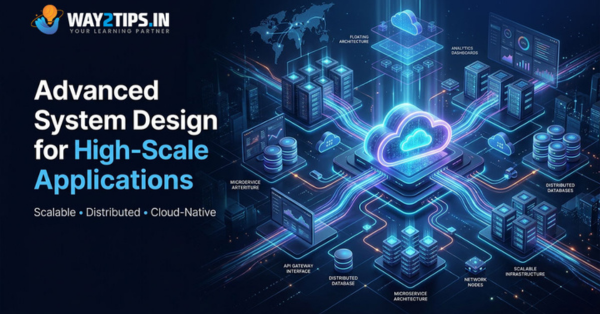
In today’s digital world, applications are expected to serve millions of users simultaneously while maintaining speed, reliability, and security. From social media platforms to e-commerce websites and streaming services, high-scale applications require strong system design principles to handle massive traffic and huge volumes of data efficiently.
Advanced system design focuses on building scalable, fault-tolerant, and highly available systems that can grow with user demand. Understanding these concepts is essential for software engineers, architects, and businesses aiming to create modern cloud-based applications.
What is System Design?
System design is the process of defining the architecture, components, databases, networking, and infrastructure required to build a software application.
It helps developers answer questions such as:
- How will the application handle millions of users?
- How can the system remain available during failures?
- How can performance be improved?
- How should data be stored and managed?
- How can the application scale efficiently?
For high-scale applications, system design becomes more complex because the system must support heavy workloads without affecting user experience.
Core Concepts of High-Scale System Design
1. Scalability
Scalability refers to the ability of a system to handle increasing traffic and workload.
There are two major types:
Vertical Scaling
Increasing the power of a single server by adding more CPU, RAM, or storage.
Advantages:
- Simple implementation
- Easy management
Disadvantages:
- Hardware limitations
- Expensive at large scale
Horizontal Scaling
Adding multiple servers to distribute traffic and workload.
Advantages:
- Better fault tolerance
- Supports massive growth
- Cost-effective for large systems
Example:
Popular platforms like Netflix and Amazon use horizontal scaling to support millions of users globally.
2. Load Balancing
A load balancer distributes incoming traffic across multiple servers to prevent overload on a single machine.
Benefits of Load Balancing
- Improved availability
- Faster response time
- Better traffic distribution
- High reliability
Common Load Balancing Algorithms
- Round Robin
- Least Connections
- IP Hash
- Weighted Distribution
Load balancers are essential for applications with high traffic volumes.
3. Caching
Caching stores frequently accessed data temporarily to reduce database load and improve speed.
Types of Caching
- Browser Cache
- CDN Cache
- Application Cache
- Database Cache
Popular Caching Tools
- Redis
- Memcached
Benefits
- Faster response time
- Reduced server workload
- Improved user experience
For example, social media applications cache user profiles and images to deliver content quickly.
4. Database Sharding
Database sharding is the process of splitting large databases into smaller parts called shards.
Each shard contains a portion of the data, allowing the system to handle massive datasets efficiently.
Advantages
- Better performance
- Faster queries
- Easier scalability
Challenges
- Complex implementation
- Difficult cross-shard queries
- Data consistency management
Large-scale applications often shard user data based on geographic region or user ID.
5. Replication
Replication involves creating copies of databases across multiple servers.
Types
- Master-Slave Replication
- Multi-Master Replication
Benefits
- High availability
- Disaster recovery
- Better read performance
If one database server fails, another replica can continue serving users.
6. Microservices Architecture
Microservices divide an application into smaller independent services.
Instead of a single monolithic application, each service handles a specific function.
Example Services
- Authentication Service
- Payment Service
- Notification Service
- Product Service
Benefits
- Independent deployment
- Easier maintenance
- Better scalability
- Faster development cycles
Companies like Uber and Spotify heavily use microservices architecture.
7. API Gateway
An API Gateway acts as the entry point for all client requests.
Responsibilities
- Authentication
- Rate limiting
- Request routing
- Monitoring
- Security
It simplifies communication between clients and microservices.
8. Message Queues
Message queues help systems process tasks asynchronously.
Popular Tools
- RabbitMQ
- Apache Kafka
- Amazon SQS
Benefits
- Better scalability
- Reduced system overload
- Improved reliability
Real-World Example
When a user uploads a video, the application may send tasks such as compression and thumbnail generation to a message queue.
9. Distributed Systems
Distributed systems use multiple servers working together to function as a single system.
Key Characteristics
- Scalability
- Fault tolerance
- High availability
Challenges
- Network failures
- Data consistency
- Synchronization issues
Distributed systems are the backbone of modern cloud computing platforms.
10. CAP Theorem
The CAP theorem states that a distributed system can guarantee only two of the following three properties at the same time:
- Consistency
- Availability
- Partition Tolerance
Example
- Banking systems prioritize consistency
- Social media platforms prioritize availability
Understanding CAP theorem helps architects choose suitable trade-offs.
High Availability and Fault Tolerance
High Availability (HA)
High availability ensures the system remains operational with minimal downtime.
Techniques
- Redundant servers
- Failover systems
- Auto-scaling
- Multi-region deployment
Fault Tolerance
Fault tolerance allows systems to continue functioning even when components fail.
Strategies
- Backup servers
- Retry mechanisms
- Circuit breakers
- Replication
Data Consistency Models
Strong Consistency
All users see the latest data immediately.
Eventual Consistency
Data becomes consistent after some time.
Example
In social media applications, likes and comments may appear with slight delays due to eventual consistency.
Content Delivery Network (CDN)
A CDN stores content across geographically distributed servers.
Benefits
- Faster content delivery
- Reduced latency
- Lower bandwidth usage
Popular CDN Providers
- Cloudflare
- Akamai
- Amazon CloudFront
CDNs improve performance for global users.
Observability and Monitoring
Monitoring is critical for large-scale applications.
Important Metrics
- CPU usage
- Memory usage
- Response time
- Error rates
- Network latency
Monitoring Tools
- Prometheus
- Grafana
- Datadog
Observability helps teams detect issues before they affect users.
Security in High-Scale Systems
Security is a critical part of system design.
Important Security Practices
- HTTPS encryption
- Authentication and authorization
- API security
- Data encryption
- DDoS protection
- Rate limiting
Large-scale applications must protect user data and prevent cyberattacks.
Cloud-Native Architecture
Modern applications increasingly use cloud-native technologies.
Key Components
- Containers
- Kubernetes
- Serverless computing
- Infrastructure as Code (IaC)
Benefits
- Rapid deployment
- Better scalability
- Reduced operational complexity
Cloud providers such as Google Cloud, Microsoft Azure, and Amazon Web Services offer powerful tools for scalable system design.
Real-World Example: Designing a Video Streaming Platform
A video streaming application requires:
- Load balancers for traffic distribution
- CDN for video delivery
- Distributed databases
- Caching systems
- Message queues for processing
- Auto-scaling infrastructure
- Monitoring systems
Workflow
- User uploads video
- Video stored in distributed storage
- Processing tasks sent to queues
- CDN distributes video globally
- Cached content improves playback speed
This architecture ensures millions of users can stream videos smoothly.
Best Practices for High-Scale System Design
Design Principles
- Keep systems modular
- Avoid single points of failure
- Use asynchronous processing
- Implement caching strategically
- Design for scalability from the beginning
- Monitor continuously
- Automate deployment and recovery
Future Trends in System Design
Emerging Technologies
- AI-driven infrastructure management
- Edge computing
- Serverless architectures
- Event-driven systems
- Multi-cloud deployment
- Real-time analytics
As user expectations grow, system design will continue evolving toward more intelligent and resilient architectures.
Conclusion
Advanced system design is essential for building reliable, scalable, and efficient high-scale applications. Concepts such as load balancing, caching, distributed systems, microservices, database sharding, and cloud-native architecture play a major role in modern software development.
Organizations that implement strong system design principles can deliver faster performance, better reliability, improved security, and seamless user experiences even under massive traffic loads.
As technology continues to evolve, mastering advanced system design concepts will remain one of the most valuable skills for developers and software architects in the digital era.
About the Author