
Introduction
In today’s fast-paced digital world, speed and efficiency are no longer optional—they are essential. As data generation continues to grow exponentially, traditional cloud computing models are struggling to keep up with real-time demands. This is where Edge Computing and 5G technology come into play.
Their integration is revolutionizing how data is processed and delivered, enabling ultra-fast communication, intelligent automation, and seamless user experiences across industries.
Understanding Edge Computing
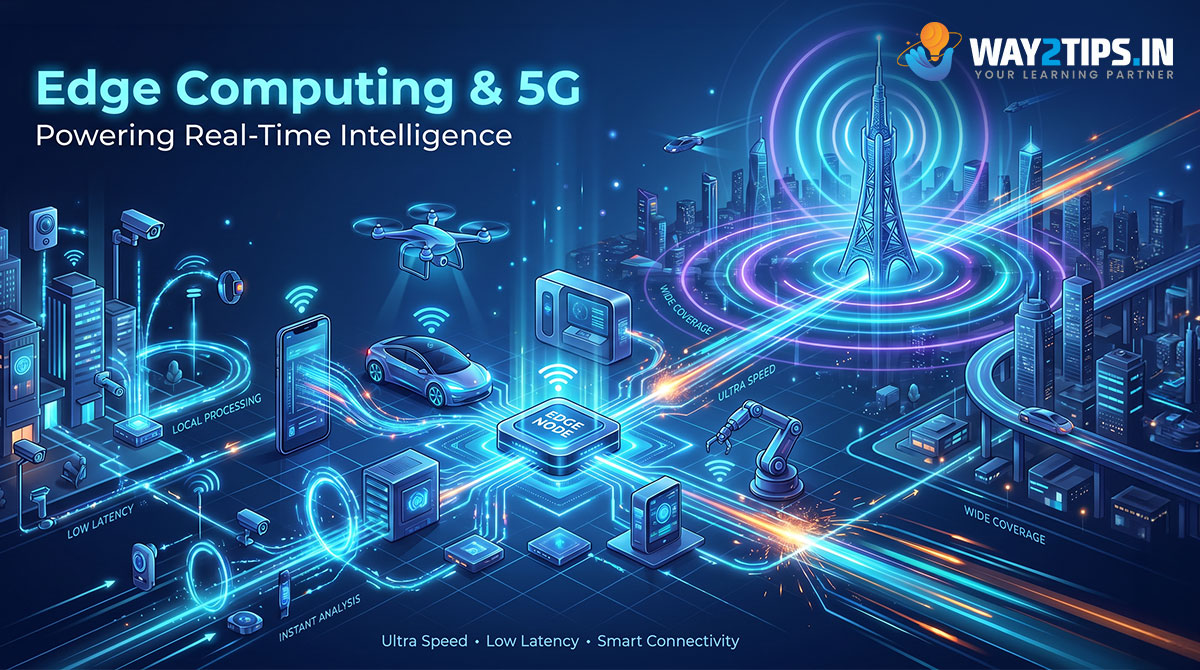
Edge computing is a decentralized computing approach where data is processed near the source—such as smartphones, IoT devices, or local servers—rather than being sent to distant cloud data centers.
This reduces the distance data must travel, resulting in faster processing and immediate decision-making.
Why Edge Computing Matters:
- Minimizes latency for real-time applications
- Reduces network congestion
- Enhances data security by keeping sensitive data local
- Enables faster insights and automation
Understanding 5G Technology
5G is the latest generation of wireless connectivity, designed to support high-speed data transmission and massive device connectivity.
Unlike previous networks, 5G is built to handle the demands of modern digital ecosystems, including smart cities, autonomous systems, and advanced applications.
Key Capabilities of 5G:
- Ultra-fast speeds (up to 10 Gbps)
- Extremely low latency (1 ms or less)
- Ability to connect billions of devices
- Highly reliable and stable connections
The Power of Integration
Individually, edge computing and 5G are powerful. Together, they create a highly efficient ecosystem where data is processed instantly and transmitted seamlessly.
- 5G provides the speed and connectivity
- Edge computing provides local intelligence and processing
This combination ensures that data-driven applications can operate in real time without delays.
How the Integration Works
- Devices (sensors, mobiles, machines) generate data
- Data is processed at nearby edge servers
- Only essential data is transmitted via 5G networks
- Cloud systems handle deeper analytics if needed
- Results are delivered instantly to users or systems
Real-World Applications
Smart Cities
Edge + 5G enables intelligent traffic systems, smart lighting, waste management, and real-time surveillance, improving urban living standards.
Healthcare
Doctors can monitor patients remotely with real-time updates. Critical applications like remote surgeries and emergency response benefit from ultra-low latency.
Autonomous Vehicles
Self-driving cars rely on instant data processing for navigation and safety. Edge computing ensures quick decision-making, while 5G enables fast communication between vehicles and infrastructure.
Industrial Automation
Factories use this integration for predictive maintenance, robotics, and real-time monitoring, improving productivity and reducing downtime.
AR & VR Experiences
Gaming, education, and training simulations become more immersive with faster rendering and minimal lag.
Key Benefits
Real-Time Performance
Applications respond instantly, which is crucial for mission-critical systems such as healthcare monitoring, autonomous vehicles, and industrial automation. Ultra-low latency ensures that decisions are made in milliseconds, reducing risks and improving operational accuracy.
Improved Efficiency
Local data processing at the edge reduces the need to send large volumes of data to centralized cloud servers. This minimizes bandwidth usage, lowers operational costs, and improves overall system performance by avoiding network congestion.
Better User Experience
Users benefit from faster app loading times, buffer-free video streaming, and highly responsive digital services. Whether it’s gaming, video calls, or smart devices, the experience becomes smoother and more reliable.
Scalability
Edge computing combined with 5G supports billions of connected devices without performance degradation. Businesses can easily scale their operations, expand IoT ecosystems, and handle increasing data loads efficiently.
Enhanced Data Security & Privacy
Sensitive data can be processed locally instead of being transmitted to distant servers. This reduces exposure to potential cyber threats and helps organizations comply with data protection regulations.
Reduced Latency in Critical Applications
Industries like healthcare, defense, and finance require instant data processing. Edge + 5G ensures minimal delay, making systems more dependable in time-sensitive situations.
Challenges
High Deployment Costs
Setting up edge infrastructure, including local data centers and 5G networks, requires significant capital investment. Small and medium businesses may find it challenging to adopt initially.
Security Concerns
With a large number of connected devices and endpoints, the attack surface increases. Without proper security frameworks, systems can become vulnerable to cyberattacks, data breaches, and unauthorized access.
Complex Architecture
Managing distributed networks across multiple edge locations can be technically complex. It requires skilled professionals, advanced monitoring tools, and efficient system integration strategies.
Data Management Issues
Handling data across multiple locations can lead to inconsistency and synchronization challenges. Ensuring data accuracy and reliability becomes more difficult in decentralized systems.
Limited 5G Coverage
Although 5G is expanding rapidly, it is still not fully available in all regions. This limits the effectiveness of edge computing in areas with poor network infrastructure.
Integration with Legacy Systems
Many organizations still rely on older systems that may not easily integrate with modern edge and 5G technologies. Upgrading these systems can be time-consuming and costly.
Future Outlook
The future of Edge Computing and 5G integration is highly promising. As adoption increases, we can expect:
- AI-driven edge devices making autonomous decisions
- Wider use in rural and remote areas
- Growth of smart homes and smart industries
- Stronger integration with cloud computing
- New innovations in robotics and automation
Conclusion
Edge Computing and 5G integration is not just a technological upgrade—it is a fundamental shift in how digital systems operate. By enabling real-time intelligence, faster communication, and scalable infrastructure, this combination is set to power the next wave of innovation across industries.
Organizations that adopt these technologies early will gain a competitive advantage in the rapidly evolving digital landscape.
About the Author