

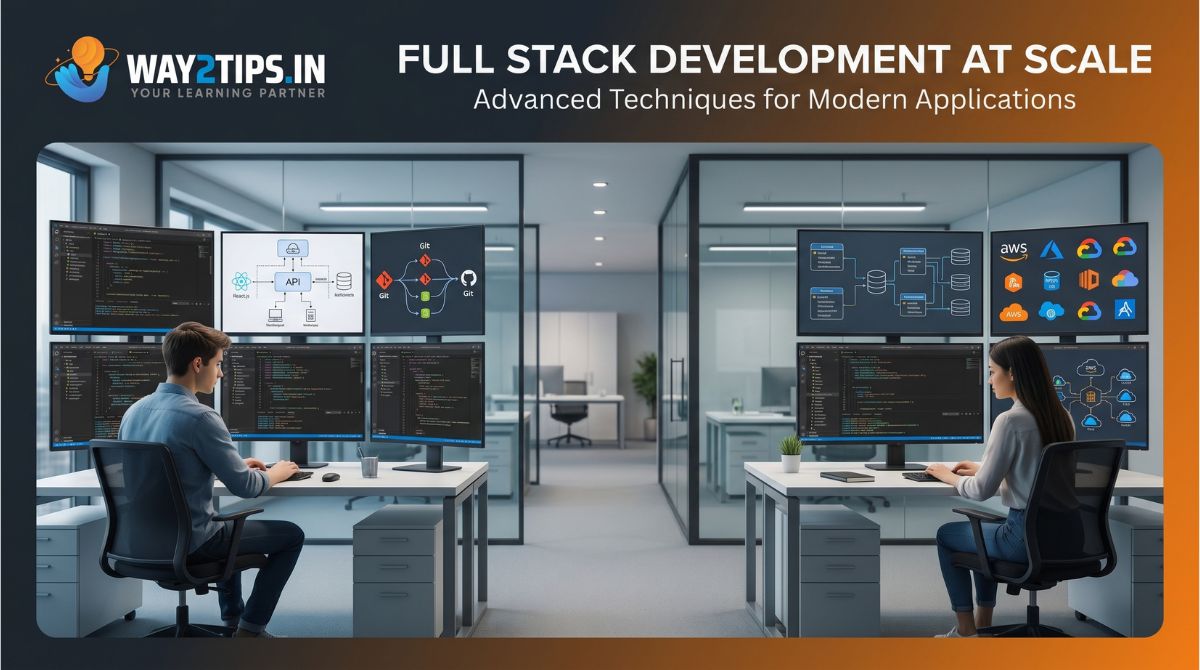
Modern applications serve millions of users across multiple devices and platforms. As businesses grow, the complexity of managing front-end interfaces, back-end services, databases, security, and cloud infrastructure increases significantly. This is where Full Stack Development at Scale becomes essential.
Scaling applications is not just about handling more users—it involves designing systems that remain reliable, secure, maintainable, and high-performing under increasing workloads. Advanced full stack developers must understand modern architectures, cloud platforms, automation, and performance optimization techniques to build scalable solutions.
What is Full Stack Development at Scale?
Full Stack Development at Scale refers to building and maintaining large-scale web applications that can efficiently support thousands or even millions of users while ensuring excellent performance and reliability.
A scalable application includes:
- Responsive Front-End
- Efficient Back-End Services
- Optimized Databases
- Cloud Infrastructure
- Automated Deployment Pipelines
- Security and Monitoring Systems
Modern Front-End Scaling Techniques
Component-Based Architecture
Large applications benefit from reusable UI components using frameworks such as React, Angular, or Vue.js.
Benefits include:
- Faster development
- Better maintainability
- Consistent user experience
- Easier testing
Code Splitting and Lazy Loading
Loading only the required components improves application performance.
Advantages:
- Faster page loading
- Reduced bandwidth usage
- Improved user experience
State Management
As applications grow, managing data becomes complex.
Popular solutions include:
- Redux
- Zustand
- NgRx
- Vuex
These tools help maintain predictable application behavior across large systems.
Scalable Back-End Architecture
Microservices Architecture
Instead of building a single large application, developers divide functionality into independent services.
Examples:
- Authentication Service
- Payment Service
- User Management Service
- Notification Service
Benefits:
- Independent deployment
- Better fault isolation
- Easier scaling
API-First Development
Modern applications rely heavily on APIs.
Best practices include:
- RESTful APIs
- GraphQL
- API versioning
- Proper documentation
Event-Driven Systems
Large-scale applications often use message queues and event streaming.
Technologies include:
- Apache Kafka
- RabbitMQ
- AWS SQS
These systems improve reliability and scalability.
Database Scaling Strategies
Database Optimization
Proper indexing and query optimization significantly improve performance.
Techniques include:
- Query caching
- Index tuning
- Connection pooling
- Database profiling
Database Replication
Read replicas distribute traffic across multiple database servers.
Benefits:
- Improved performance
- Better availability
- Load balancing
Database Sharding
Large datasets are divided across multiple servers.
Advantages:
- Faster data retrieval
- Increased storage capacity
- Improved scalability
Cloud-Native Development
Cloud platforms provide flexible infrastructure for scaling applications.
Popular platforms include:
- AWS
- Microsoft Azure
- Google Cloud Platform
Key cloud services:
- Virtual Machines
- Serverless Functions
- Managed Databases
- Object Storage
Cloud-native architecture enables businesses to scale resources based on demand.
Containerization and Orchestration
Docker
Containers package applications and dependencies together.
Benefits:
- Consistent environments
- Faster deployment
- Easier management
Kubernetes
Kubernetes automates container deployment and scaling.
Features:
- Auto-scaling
- Load balancing
- Self-healing systems
- Rolling updates
DevOps and CI/CD Automation
Continuous Integration and Continuous Deployment improve software delivery speed.
Popular tools:
- GitHub Actions
- GitLab CI/CD
- Jenkins
- Azure DevOps
Benefits include:
- Faster releases
- Reduced errors
- Automated testing
- Improved collaboration
Performance Optimization Techniques
Caching
Caching reduces database load and improves response times.
Tools include:
- Redis
- Memcached
- CDN Services
Load Balancing
Traffic is distributed across multiple servers.
Benefits:
- Better reliability
- Improved performance
- High availability
Content Delivery Networks (CDN)
CDNs deliver content from locations closer to users.
Advantages:
- Faster website loading
- Reduced latency
- Improved global performance
Security at Scale
Security becomes increasingly important as applications grow.
Key security measures include:
- Multi-Factor Authentication (MFA)
- Role-Based Access Control (RBAC)
- API Security
- Encryption
- Secure Coding Practices
- Vulnerability Scanning
Regular security audits help identify and resolve potential risks.
Monitoring and Observability
Scalable systems require continuous monitoring.
Popular tools:
- Prometheus
- Grafana
- Datadog
- New Relic
- ELK Stack
Monitoring helps developers:
- Detect issues early
- Track performance
- Improve reliability
- Reduce downtime
Future of Full Stack Development
Emerging technologies are transforming full stack development:
- Artificial Intelligence Integration
- Serverless Computing
- Edge Computing
- WebAssembly
- Low-Code Development Platforms
- Cloud-Native Applications
Developers who master these technologies will be well-positioned for the future of software engineering.
Conclusion
Full Stack Development at Scale requires more than knowledge of front-end and back-end technologies. It involves designing resilient architectures, optimizing performance, automating deployments, securing applications, and leveraging cloud infrastructure effectively.
By mastering advanced techniques such as microservices, containerization, cloud-native development, CI/CD automation, database optimization, and monitoring, developers can build applications capable of supporting millions of users while maintaining exceptional performance and reliability.
About the Author