
Introduction
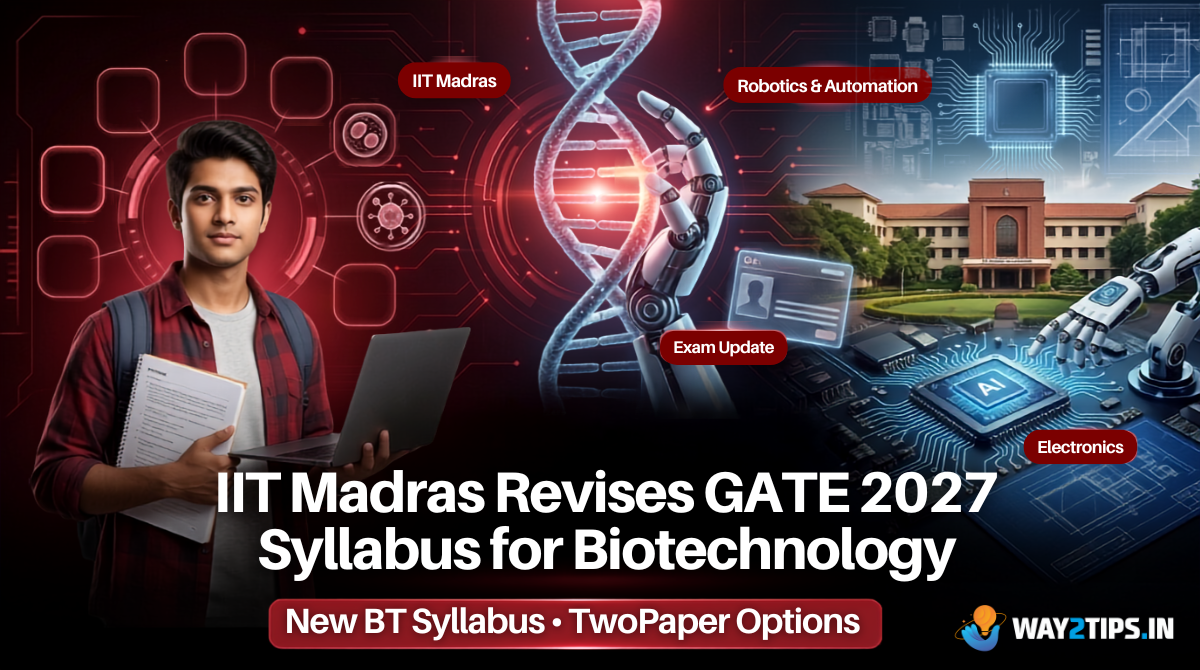
The Graduate Aptitude Test in Engineering (GATE 2027) is set to bring significant changes for engineering and science graduates across India. IIT Madras, the organising institute for GATE 2027, has officially released a revised information brochure introducing updates to the GATE 2027: IIT Madras Revises Biotechnology Syllabus and Two-Paper Combinations and subject-specific modifications aimed at improving interdisciplinary learning.
The announcement comes during a period of major developments in India’s higher education system. Following the nationwide NEET-UG paper leak controversy, Union Education Minister Dharmendra Pradhan resigned, and Pralhad Joshi assumed charge of the Education Ministry. The Government of India has also established a high-level reform committee headed by Nandan Nilekani to recommend comprehensive reforms for the National Testing Agency (NTA). Meanwhile, the CAT 2026 notification has also been officially released, making this a crucial period for aspirants preparing for competitive examinations.
IIT Madras Releases Revised GATE 2027 Information Brochure
According to the latest notification, IIT Madras has updated the official GATE 2027 brochure with important revisions affecting:
- Biotechnology (BT) syllabus
- Two-paper combinations
- Subject-wise syllabus updates
The institute clarified that there is no change in the GATE 2027 exam schedule, eligibility criteria, application process, examination pattern, or admission rules.
Candidates can continue preparing according to the announced examination calendar while incorporating the revised syllabus into their study plans.
GATE 2027 Exam Schedule Remains Unchanged
The exam schedule for GATE 2027 remains exactly as previously announced.
Key highlights include:
- Examination conducted by IIT Madras
- Total of 30 test papers
- Each paper carries 100 marks
- Examination language remains English
- Computer-based examination
- Existing eligibility criteria remain unchanged
Students do not need to worry about any changes to registration dates or examination timelines.
Expanded Two-Paper Combinations in GATE 2027
One of the biggest highlights of GATE 2027 is the expansion of two-paper combinations, allowing candidates to combine related disciplines and improve opportunities for postgraduate admissions and PSU recruitment.
Robotics and Automation (RA)
Candidates choosing Robotics and Automation can now opt for:
- Computer Science and Information Technology (CS)
- Data Science and Artificial Intelligence (DA)
- Electronics Engineering (EC)
- Electrical Engineering (EE)
- Instrumentation Engineering (IN)
- Mechanical Engineering (ME)
Previously, only CS, DA, EE and ME combinations were permitted. The inclusion of Electronics Engineering and Instrumentation Engineering reflects the increasing demand for multidisciplinary skills in automation and robotics.
Electronics Engineering (EC)
Students opting for Electronics Engineering now have an additional option.
Updated combinations include:
- Computer Science (CS)
- Data Science and Artificial Intelligence (DA)
- Electrical Engineering (EE)
- Instrumentation Engineering (IN)
- Physics (PH)
- Robotics and Automation (RA)
The addition of RA strengthens the connection between electronics, embedded systems and industrial automation.
Instrumentation Engineering (IN)
Instrumentation Engineering candidates can now combine their paper with:
- Biomedical Engineering (BM)
- Electronics Engineering (EC)
- Electrical Engineering (EE)
- Mechanical Engineering (ME)
- Robotics and Automation (RA)
This revision offers broader opportunities for students interested in smart manufacturing, industrial automation and control systems.
Major Updates to the Biotechnology Syllabus
The revised Biotechnology syllabus has been redesigned to align with modern research, industry requirements and technological advancements.
Several important sections have been updated and reorganised.
New Fundamentals of Biological Engineering Section
IIT Madras has merged two existing sections into a completely new chapter titled:
Fundamentals of Biological Engineering
This new structure integrates engineering principles with biological sciences, helping students develop stronger conceptual understanding.
Reorganised Engineering Concepts
Core engineering topics have been restructured, including:
- Material balances
- Energy balances
- Thermodynamics
- Transport processes
Instead of being treated independently, these concepts are now integrated within biological engineering applications.
Engineering Mathematics Receives New Topics
The revised syllabus introduces additional mathematical concepts that are increasingly important in biotechnology research.
New topics include:
- Bayesian Statistics
- Vector Calculus
These topics support data modelling, computational biology, bioinformatics and machine learning applications.
Greater Focus on General Biology
The General Biology section has also been expanded considerably.
Students are expected to develop stronger understanding in:
- Metabolism
- Immunology
- Microbiology
- Cellular functions
- Molecular biology
The revised syllabus reflects current developments in biotechnology, healthcare and pharmaceutical research.
Recombinant DNA Technology Updated
Several advanced biotechnology concepts have now been added.
New topics include:
- Recombination-based cloning
- Biosensors
- Omics technologies
- Modern molecular biology tools
- Advanced genetic engineering techniques
These additions make the syllabus more relevant for present-day biotechnology research and industrial applications.
Eligibility Criteria Remain the Same
Despite syllabus updates, eligibility criteria remain unchanged.
Candidates satisfying the existing academic qualifications can apply for GATE 2027 without any additional requirements.
There are also no changes to:
- Registration process
- Application fee
- Examination pattern
- Marking scheme
- Result declaration process
GATE 2027 and India’s Examination Reforms
The GATE 2027 announcement comes during major reforms in India’s examination system.
Following the nationwide NEET-UG paper leak controversy, the education sector witnessed significant administrative changes.
Important developments include:
- Union Education Minister Dharmendra Pradhan resigned after widespread student protests.
- Pralhad Joshi has taken charge of the Education Ministry.
- A high-powered committee led by Nandan Nilekani has been established to recommend reforms for the National Testing Agency (NTA).
- The task force is expected to improve transparency, security and accountability in national-level entrance examinations.
These reforms are expected to strengthen the credibility of future competitive examinations across the country.
CAT 2026 Notification Also Released
In another important development for higher education aspirants, the CAT 2026 notification has been officially released.
Students planning careers in management can now begin preparing for admissions into prestigious Indian Institutes of Management (IIMs) and other leading business schools while engineering graduates continue preparing for GATE 2027.
Why These Changes Matter
The latest updates indicate a strong focus on interdisciplinary education.
The revised syllabus will help students prepare for emerging fields such as:
- Artificial Intelligence
- Robotics
- Bioinformatics
- Industrial Automation
- Genomics
- Biomedical Engineering
- Data Science
- Biotechnology Research
By expanding two-paper combinations and updating the Biotechnology syllabus, IIT Madras aims to ensure that GATE 2027 remains aligned with evolving academic and industry requirements.
Preparation Tips for GATE 2027 Aspirants
To maximise performance, candidates should:
- Download the latest IIT Madras GATE 2027 syllabus.
- Compare the revised Biotechnology syllabus with previous versions.
- Focus on newly added topics such as Bayesian Statistics and Vector Calculus.
- Strengthen General Biology concepts including immunology, metabolism and microbiology.
- Practise previous years’ GATE papers.
- Choose two-paper combinations strategically based on career goals.
- Follow the official exam schedule and complete preparation well before the examination.
Conclusion
The revisions introduced by IIT Madras for GATE 2027 represent one of the most important updates in recent years. The enhanced Biotechnology syllabus, expanded two-paper combinations, and continued emphasis on interdisciplinary education will benefit thousands of aspirants preparing for postgraduate admissions, PSU recruitment and research careers.
With the exam schedule and eligibility criteria remaining unchanged, candidates should now focus on understanding the revised syllabus and planning their preparation accordingly. At the same time, the broader education reforms involving the National Testing Agency (NTA), leadership changes in the Education Ministry, and the release of the CAT 2026 notification signal a transformative phase for India’s competitive examination ecosystem.
About the Author