
Artificial Intelligence (AI) is transforming the world faster than any previous technological revolution. From healthcare and finance to education and entertainment, AI is changing how industries operate and how people work. While automation is replacing repetitive tasks, it is also creating new opportunities for individuals who possess advanced skills. In this rapidly evolving digital era, advanced skills are no longer optional — they are essential for career growth, innovation, and long-term success.
Understanding the AI Revolution
AI refers to machines and software systems capable of performing tasks that usually require human intelligence, such as problem-solving, decision-making, language understanding, and pattern recognition. Technologies like machine learning, robotics, natural language processing, and generative AI are now being integrated into everyday business operations.
Reports from organizations like the World Economic Forum and the International Monetary Fund highlight that millions of jobs will be transformed by AI over the next decade. However, the same reports also emphasize that new roles will emerge for people who continuously learn and adapt.
Why Advanced Skills Matter
In the age of AI, technical knowledge alone is not enough. Employers are increasingly searching for professionals who can combine technology expertise with creativity, communication, and strategic thinking. Advanced skills help individuals remain valuable even as automation grows.
These skills allow people to:
- Work effectively alongside AI systems
- Solve complex problems creatively
- Make informed decisions using data
- Lead teams and manage innovation
- Adapt to changing technologies quickly
As AI handles repetitive and routine tasks, human workers are expected to focus on areas that require emotional intelligence, critical thinking, and ethical judgment.
Key Advanced Skills Needed in the AI Era
1. Digital and AI Literacy
Understanding how AI works has become a fundamental skill. Employees do not necessarily need to become AI engineers, but they should understand basic AI concepts, data usage, automation tools, and digital platforms.
AI literacy helps professionals:
- Use AI tools productively
- Analyze AI-generated outputs
- Make better technology-related decisions
- Stay competitive in modern workplaces
Organizations worldwide are investing heavily in AI training because businesses increasingly depend on AI-driven operations.
2. Critical Thinking and Problem-Solving
AI can process huge amounts of information quickly, but humans are still better at interpreting complex situations and making contextual decisions. Critical thinking enables individuals to evaluate information carefully, identify risks, and create innovative solutions.
Problem-solving skills are especially important in:
- Business strategy
- Software development
- Healthcare
- Research and development
- Cybersecurity
People who can think analytically and creatively will continue to play a vital role in organizations.
3. Communication Skills
Strong communication remains one of the most valuable human abilities. In AI-powered workplaces, professionals must explain ideas clearly, collaborate with teams, and communicate technical information to non-technical audiences.
Communication skills include:
- Public speaking
- Presentation skills
- Negotiation
- Writing and reporting
- Cross-cultural communication
Recent workforce studies show that soft skills are becoming even more valuable as automation expands.
4. Emotional Intelligence (EQ)
Emotional intelligence refers to the ability to understand emotions, build relationships, and manage interpersonal interactions effectively. AI systems can analyze data, but they cannot truly understand human emotions or empathy.
EQ is essential for:
- Leadership roles
- Team management
- Customer service
- Human resources
- Counseling and mentoring
In many industries, emotional intelligence is considered “AI-resistant” because it depends heavily on human connection and empathy.
5. Creativity and Innovation
AI can generate content and automate designs, but original human creativity remains irreplaceable. Creative thinking drives innovation, product development, storytelling, marketing campaigns, and artistic expression.
People with innovative thinking skills can:
- Develop new business ideas
- Create unique products
- Improve customer experiences
- Build creative solutions to complex problems
Companies value employees who can combine AI tools with human imagination to produce better outcomes.
6. Data Analysis and Decision-Making
Data has become one of the most valuable resources in the digital economy. Professionals who can interpret data and make informed decisions are in high demand.
Advanced data-related skills include:
- Data visualization
- Statistical analysis
- Business intelligence
- Predictive analytics
- AI-assisted decision-making
AI systems generate insights, but humans are still needed to interpret results responsibly and strategically.
The Impact of AI on Jobs
AI will not simply eliminate jobs; it will reshape them. Routine and repetitive tasks are more likely to be automated, while jobs requiring human creativity, leadership, and judgment will continue to grow.
Some emerging AI-era careers include:
- AI specialists
- Data scientists
- Prompt engineers
- AI ethics consultants
- Robotics engineers
- Cybersecurity analysts
- AI product managers
Research also shows that AI skills significantly improve hiring opportunities across industries.
Challenges in the AI Era
Although AI offers many opportunities, it also creates challenges:
Skill Gaps
Many workers lack the advanced skills required for AI-driven workplaces. Businesses and governments must invest in training programs to bridge this gap.
Ethical Concerns
AI systems can raise concerns related to privacy, bias, and misinformation. Professionals with ethical reasoning and governance skills are increasingly important.
Job Displacement
Some traditional roles may disappear due to automation. Workers need support for reskilling and career transitions.
Mental Adaptation
Rapid technological change can create stress and uncertainty. Adaptability and resilience are becoming critical life skills.
The Role of Education
Educational institutions must redesign learning systems to prepare students for the future. Modern education should focus not only on memorization but also on:
- Practical learning
- Digital literacy
- Creativity
- Collaboration
- Leadership
- Innovation
Schools and universities should integrate AI tools responsibly while teaching students how to think independently.
Building a Future-Ready Workforce
Governments, companies, and individuals all share responsibility for building a future-ready workforce.
Companies Should:
- Offer employee reskilling programs
- Encourage innovation and creativity
- Promote ethical AI practices
- Support continuous learning
Governments Should:
- Invest in digital education
- Create AI training initiatives
- Support workforce transitions
- Encourage technology accessibility
Individuals Should:
- Stay curious and adaptable
- Learn new digital skills
- Develop both technical and soft skills
- Embrace lifelong learning
Conclusion
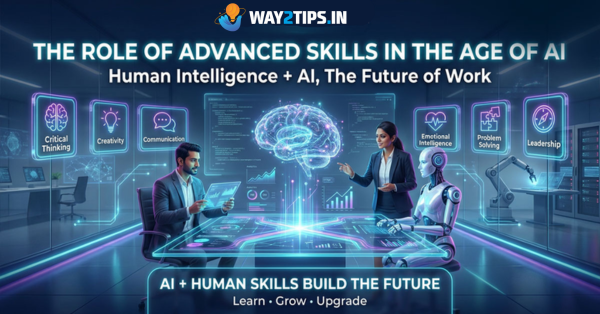
The age of AI is not about humans competing against machines; it is about humans learning to work effectively with technology. Advanced skills such as critical thinking, emotional intelligence, creativity, communication, and AI literacy are becoming the foundation of future success.
As AI continues to reshape industries and workplaces, individuals who invest in learning and skill development will have greater opportunities to thrive. The future belongs not only to those who understand technology but also to those who can apply uniquely human abilities in meaningful and innovative ways.
About the Author