

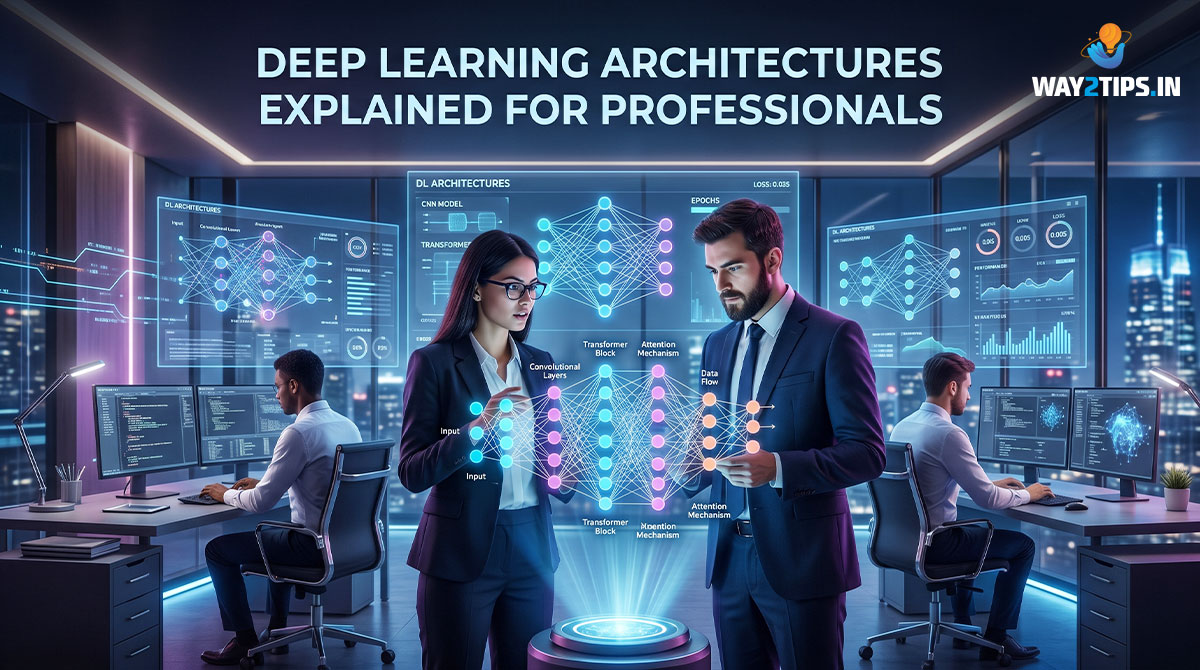
Artificial Intelligence is transforming industries at an incredible pace, and Deep Learning stands at the center of this revolution. From intelligent chatbots and self-driving cars to medical diagnosis systems and advanced recommendation engines, deep learning architectures are powering the next generation of smart applications.
For professionals working in software, data science, analytics, automation, or cloud technologies, understanding deep learning architectures is becoming increasingly important. This article explains the most influential deep learning architectures in a practical and professional way.
What Is Deep Learning?
Deep Learning is a branch of Machine Learning that uses artificial neural networks with multiple layers to learn patterns from massive amounts of data. Unlike traditional machine learning models, deep learning systems automatically extract features without requiring extensive manual programming.
These architectures are designed to process complex data such as:
- Images
- Videos
- Audio
- Natural language
- Time-series data
- Large-scale business datasets
Deep learning models improve continuously as they receive more data and computational power.
Why Deep Learning Architectures Matter
A deep learning architecture defines how neural network layers are structured and how information flows through the system. Different architectures are optimized for different tasks.
Choosing the right architecture helps professionals:
- Improve prediction accuracy
- Reduce training time
- Handle large datasets efficiently
- Build scalable AI applications
- Solve industry-specific problems faster
Understanding architectures also helps organizations select the right AI strategy for business growth.
1. Artificial Neural Networks (ANN)
Artificial Neural Networks are the foundation of deep learning. They are inspired by the human brain and consist of interconnected neurons arranged in layers.
Structure of ANN
- Input Layer
- Hidden Layers
- Output Layer
Each neuron processes information and passes it to the next layer.
Common Use Cases
- Sales forecasting
- Fraud detection
- Customer analytics
- Business intelligence
- Financial predictions
Advantages
- Learns nonlinear relationships
- Flexible for many applications
- Good for structured datasets
Limitations
- Requires large training datasets
- Can become computationally expensive
- Less effective for image and sequence processing
2. Convolutional Neural Networks (CNN)
Convolutional Neural Networks are specialized for image and visual data processing. CNNs automatically detect patterns such as edges, shapes, textures, and objects.
Key Components
- Convolution layers
- Pooling layers
- Fully connected layers
Real-World Applications
- Facial recognition
- Medical imaging
- Autonomous vehicles
- Security surveillance
- Retail product recognition
Why Professionals Prefer CNNs
CNNs dramatically reduce manual image feature extraction and deliver high accuracy in computer vision tasks.
Popular CNN Models
- LeNet
- AlexNet
- VGGNet
- ResNet
- EfficientNet
3. Recurrent Neural Networks (RNN)
Recurrent Neural Networks are designed for sequential data where previous information influences future predictions.
Unlike traditional neural networks, RNNs contain memory mechanisms.
Applications
- Speech recognition
- Language translation
- Chatbots
- Predictive typing
- Stock market forecasting
Strengths
- Handles sequential patterns
- Useful for time-series analysis
- Maintains contextual understanding
Challenges
Traditional RNNs struggle with long-term dependencies due to vanishing gradient problems.
4. Long Short-Term Memory Networks (LSTM)
LSTM networks are advanced versions of RNNs created to solve memory-related limitations.
They use specialized gates to remember or forget information over long periods.
Main Features
- Input gate
- Forget gate
- Output gate
Industry Applications
- Voice assistants
- Financial forecasting
- Weather prediction
- Healthcare monitoring
- NLP systems
Benefits
- Better long-term memory handling
- Improved sequence learning
- More accurate predictions
5. Transformer Architecture
Transformers are currently among the most powerful deep learning architectures. They revolutionized Natural Language Processing (NLP).
Modern AI tools such as large language models rely heavily on transformer-based architectures.
Key Innovation
Transformers use a mechanism called Self-Attention, allowing models to understand relationships between words regardless of position.
Applications
- AI chatbots
- Content generation
- Language translation
- Search engines
- Code generation
- Virtual assistants
Advantages
- Parallel processing
- Faster training
- Superior NLP performance
- Scalable for massive datasets
Popular Transformer Models
- BERT
- GPT
- T5
- RoBERTa
- PaLM
6. Generative Adversarial Networks (GANs)
GANs are designed for generating realistic synthetic data.
They consist of two competing networks:
- Generator
- Discriminator
The generator creates fake data, while the discriminator evaluates authenticity.
Applications
- AI-generated art
- Deepfake technology
- Image enhancement
- Gaming graphics
- Fashion design
- Synthetic medical data
Advantages
- Creates highly realistic outputs
- Useful for creative AI systems
- Enhances limited datasets
Risks
GANs can also be misused for misinformation and fake media creation.
7. Autoencoders
Autoencoders are neural networks used for data compression and reconstruction.
They learn efficient representations of input data.
Common Uses
- Anomaly detection
- Image denoising
- Recommendation systems
- Data compression
- Feature extraction
Professional Benefits
Autoencoders help organizations reduce storage needs and improve data efficiency.
8. Deep Reinforcement Learning (DRL)
Deep Reinforcement Learning combines deep learning with reinforcement learning techniques.
An AI agent learns by interacting with an environment and receiving rewards or penalties.
Applications
- Robotics
- Game AI
- Autonomous systems
- Smart manufacturing
- Trading systems
Key Advantages
- Learns through experience
- Adapts dynamically
- Useful for decision-making systems
Choosing the Right Architecture
Professionals should select architectures based on the problem type.
| Problem Type | Recommended Architecture |
|---|---|
| Image Processing | CNN |
| Text Generation | Transformer |
| Sequential Data | RNN / LSTM |
| Synthetic Content | GAN |
| Anomaly Detection | Autoencoder |
| Decision Systems | Deep Reinforcement Learning |
Understanding business goals and dataset characteristics is essential before model selection.
Challenges in Deep Learning
Although deep learning offers impressive capabilities, organizations still face several challenges.
1. High Computational Cost
Training large models requires expensive GPUs and cloud infrastructure.
2. Massive Data Requirements
Deep learning systems perform best with large, high-quality datasets.
3. Explainability Issues
Many models behave like “black boxes,” making decisions difficult to interpret.
4. Ethical Concerns
Bias, privacy, misinformation, and AI misuse remain major concerns.
5. Deployment Complexity
Moving models from development to production requires strong MLOps practices.
Future of Deep Learning Architectures
The future of deep learning is moving toward:
- Smaller and faster AI models
- Multimodal AI systems
- Edge AI computing
- Energy-efficient architectures
- Autonomous AI agents
- Explainable AI frameworks
Businesses adopting AI-driven architectures early will gain competitive advantages across industries.
Skills Professionals Should Learn
To succeed in AI and deep learning careers, professionals should focus on:
- Python programming
- TensorFlow
- PyTorch
- Neural network fundamentals
- Data engineering
- Cloud AI platforms
- MLOps
- AI ethics
Practical project experience is equally important alongside theoretical knowledge.
Final Thoughts
Deep learning architectures are shaping the future of technology and digital transformation. From CNNs for computer vision to Transformers powering advanced AI assistants, each architecture solves unique business and technical challenges.
Professionals who understand these architectures can build smarter applications, improve automation, and unlock powerful AI-driven opportunities in their industries.
As AI adoption continues to accelerate globally, deep learning knowledge is no longer optional for modern technology professionals — it is becoming a core skill for the future workforce.
About the Author